


If you’re looking for used Ford Transit vans, you will quickly encounter descriptions such as L1 H1, L2 H2 or L3 H3. If you do not buy commercial vehicles regularly, those combinations can make two otherwise similar-looking vans surprisingly difficult to compare.
Fortunately, the basic principle is straightforward. The L number relates to the vehicle’s length or wheelbase category, while the H number describes the height of the roof.
Understanding both can help you choose a van that actually accommodates your tools, stock or equipment without buying more space than your business needs.
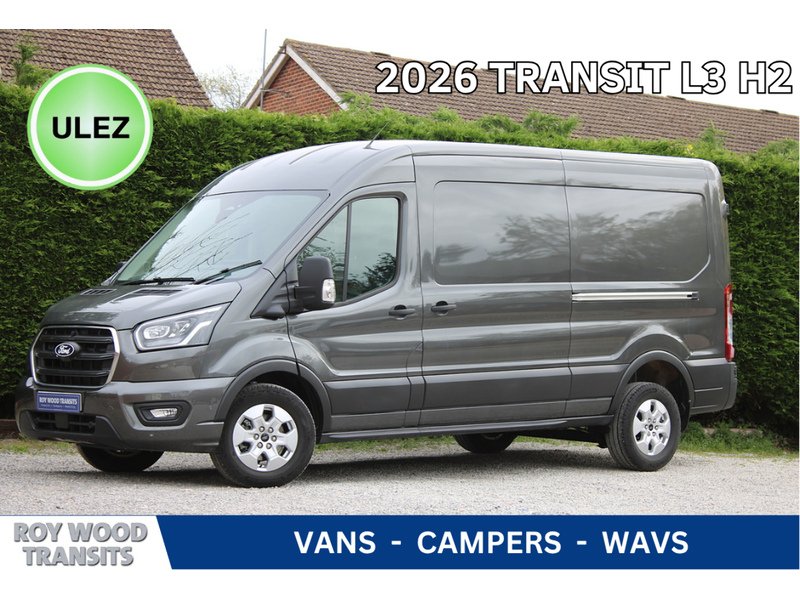
What Does the L Number Mean on a Ford Transit?
The “L” is used to distinguish different vehicle lengths within a particular Ford Transit model range.
Broadly:
- L1 is a shorter body or wheelbase option.
- L2 is the next length available.
- L3 is a longer configuration.
- Some full-size Transits are also available as L4, providing an extended body length.
You will often see these described using terms such as short wheelbase, medium wheelbase and long wheelbase.
There is one important point when comparing used Ford Transit vans, however: an L2 does not represent one universal measurement across every Transit.
For example, an L1 Transit Custom and an L2 full-size Transit belong to different vehicle ranges. Model generation can also affect dimensions. Always check the actual stated vehicle and loadspace measurements rather than choosing from the L number alone.
What Do H1, H2 and H3 Mean?
The H number describes the roof-height category.
In simple terms:
- H1 means a lower roof.
- H2 means a medium roof.
- H3 means a higher roof.
A higher roof can provide considerably more useful vertical loadspace, particularly if you carry bulky equipment, stack goods or want enough internal height to move around more comfortably.
However, extra height is not automatically always an advantage. If your work involves frequently entering underground car parks, height-restricted entrances or parking in busy cities or towns, the overall vehicle height deserves careful consideration.
Is an L2 H2 the Same Size on Every Ford Transit?
No, and this is one of the most useful things to remember when searching for a Ford Transit for sale.
L and H codes identify a configuration within a model range; they should not be treated as fixed measurements that apply to every Transit ever produced.
A Transit Custom L1 H1, for instance, is a different proposition from a full-size Transit L2 H2. The vehicle’s age, body style and generation can also matter.
Roy Wood Transits’ listings illustrate the difference. A used Transit Custom L1 H1 has been advertised with approximately 2,400mm of load length, while a full-size Transit L2 H2 listing offered around 2,900mm. An L3 H3 full-size Transit was listed with around 3,400mm.
This is why the dimensions within the individual vehicle specification are ultimately more important than the code on its own.
Which Transit Length Should You Choose?
Start with what you regularly carry rather than simply choosing the biggest panel van within budget.
A shorter vehicle may suit tradespeople carrying tools and relatively compact equipment, particularly where easy manoeuvring and parking are priorities.
Moving to an L2 or L3 can make more sense if you routinely transport longer materials, larger quantities of stock or equipment that cannot easily be stacked.
Before viewing a van, it can be worth measuring the longest objects you regularly carry. That might be pipework, timber, ladders, machinery or packaged goods.
An extra few hundred millimetres of usable load length can make a significant difference if it allows equipment to be carried safely inside rather than requiring another solution.
Do You Need H1, H2 or H3?
Think about the shape of your load as well as its overall volume.
A lower-roof van may provide all the capacity required if most items are relatively low and easy to stack. A higher roof becomes more useful when carrying tall equipment or large-volume loads.
For some businesses, additional internal height can also make loading, organising stock and accessing fitted van racking easier.
Do not forget the external height, though. If the van regularly visits multi-storey car parks, warehouses or premises with restricted access, check those limits against the vehicle’s actual specification.
Does a Larger Transit Automatically Have a Bigger Payload?
Not necessarily. The payload and physical loadspace are two different things. A van may have enough room to physically fit everything you want to carry while still exceeding its permitted weight.
Payload can be affected by factors such as vehicle specification, body style, drivetrain, fitted equipment and the van’s gross vehicle weight.
That makes payload particularly important when comparing used commercial vans for heavy tools, machinery or dense materials.
Check both the available space and the individual vehicle’s permitted payload rather than assuming a larger body automatically allows you to carry more weight.
Questions to Ask When Comparing Used Ford Transit Vans
Once you understand the L and H codes, compare the details that affect how the van will actually be used.
Consider your required load length, internal height, payload, door access and whether equipment such as racking will be installed. You should also think about where the van will be parked and whether additional vehicle length or height could create everyday difficulties.
The ideal Transit is not necessarily the largest one available. It is the configuration that provides enough usable capacity without adding unnecessary size for the work you do.
Find the Right Used Ford Transit With Roy Wood Transits
When comparing used Ford Transit vans, understanding L1, L2, L3 and the different roof heights gives you a useful starting point. The next step is checking the individual vehicle’s measurements and specification.
Roy Wood Transits specialises in selling vans for both private and commercial use. Our friendly team is always happy to advise you on our latest vehicles.
Explore our latest range of new and used Ford Transit vans for sale.